Payment Orchestration: A Scalable Orchestration Layer for Every Merchant

By 2026, the average online store works with three or more payment providers at the same time. This creates significant operational complexity: different contracts, API, dashboards, and reconciliation processes. Payment orchestration solves this problem by implementing an intelligent orchestration layer on top of the entire payment infrastructure. This layer acts as a single logical center that receives a transaction request from the website and automatically decides through which provider, by which method, and by which route to process it. After reading this article, it will be possible to understand more deeply how Payment Orchestration helps business.
How Payment Orchestration Work: The Engine of Modern Commerce
The operating principle of global payment orchestration is based on abstraction and automation. Instead of direct interaction with a dozen payment gateway, business integrates once with a platform. This orchestrator takes on all the logic of interaction with underlying payment services, the acquiring bank, and alternative payment methods. It is important to understand that an orchestrator works with multiple merchant account at the same time, which fundamentally distinguishes it from a direct connection to one gateway. The difference between these basic concepts is clarified by the comparison merchant account vs payment gateway. Such an approach transforms the payment stack from a set of disparate tools into a coordinated system.
One Layer. Infinite Possibilities.
Streamlining Payment Flows with a Single API
A single program interface (API) is one of the orchestration tools. Through it, the entire required volume of payment information for initiating a transaction is transmitted. The payment orchestration solution on its side performs the heavy work: it determines secure payment methods for a given client and region, selects the optimal provider, formats the request into the required standard, and sends it. For business, this entire complex payment process looks like one API call. This sharply reduces labor costs for integrating multiple payment providers and accelerates the launch of new payment technologies. The technical implementation of such an approach is described in detail in the guide to Payment Gateway API.
The Role of the Orchestrator in Smart Routing
Smart routing is the core that turns an orchestrator from a simple proxy into a strategic tool. The orchestration layer analyzes each transaction in real time by a set of rules. These rules can take into account the client’s country and currency, product type, payment history, current load, and the cost of services of each connected payment processor.
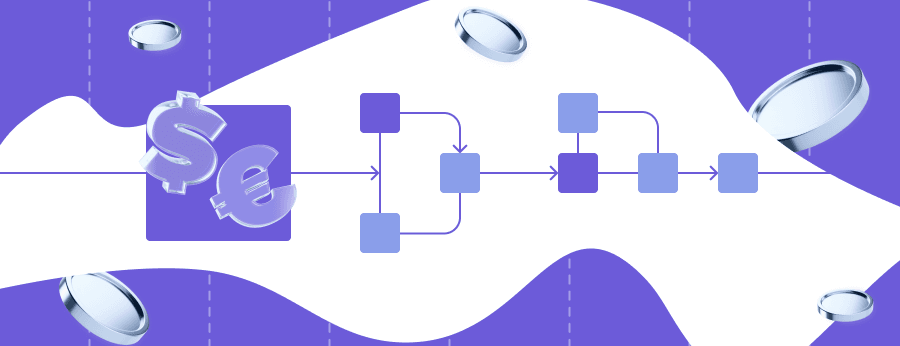
For example, for a client from Germany, the system will automatically choose the local method Sofortüberweisung, and for a recurring payment from a verified client it will route it through the path with the lowest fee. This allows dynamically optimize payment flows to maximize conversion and minimize costs.
Why Businesses are Using a Payment Orchestration Platform
The transition to an orchestration platform is a response to the challenges of growth and geographic expansion. Business no longer wants to be locked into a single payment service provider or spend months integrating with each new local method. Using a payment orchestration platform gives control over the entire payment ecosystem, allowing flexible management of its components. This control directly affects key business metrics: payment conversion, operating costs, and the quality of the client experience.
Core Benefits of Payment Orchestration
Implementing orchestration brings business several measurable benefits. They follow from the architecture of the solution, where the orchestrator acts as a single point of control.
Increased conversion and reduced failure risk
Smart payment routing sends the transaction through the most stable channel. If one gateway fails, the system instantly switches to a backup, ensuring a seamless experience for the client.
Vendor independence and flexibility
The platform breaks the rigid binding to one provider. You can add, test, and change multiple payment gateways without changing internal integration, achieving better terms.
Centralized management and security
All payment data flows into one dashboard. A single entry point simplifies operations, monitoring, and compliance with security standards such as PCI DSS.
There are other advantages, nevertheless the focus is on the listed ones.
Managing Global Payment Solutions Efficiently
For global sales, support for local payment options becomes a necessity. Orchestration platforms solve this task by providing access to hundreds of regional payment and alternative payment methods through one integration. It is not required to sign separate contracts with iDEAL providers in the Netherlands, Cartes Bancaires in France, or Pix in Brazil. The orchestrator platform already has these connections and provides them as a service. This allows business to enter new markets quickly, offering clients various payment methods, which directly leads to conversion growth.
Strategic Integration: Beyond a Single Payment Service Provider
The strategic value of orchestration is revealed at the level of business management. It allows viewing payment infrastructure not as an expense item, but as a tool for optimizing financial flows and gaining competitive advantage. A properly configured orchestration platform becomes a data source and a lever for reducing costs.
Optimizing Costs When Using a Payment Orchestration Strategy
A direct economic effect is achieved due to competition between providers inside the ecosystem. Payment orchestration enables merchants to configure routing rules that minimize payment processing fees. For example, for transactions above a certain amount it is possible to choose an acquirer with a better rate, and for micropayments an acquirer with a minimal fixed fee.

The system can automatically distribute load between banks, using their pricing plans. This is difficult to implement when working with one payment service provider. To understand the interaction of participants in the process, it is useful to study the difference between acquiring bank and issuing bank.
Unified Analytics and the "One Payment" Experience
Orchestration creates a unified information field for all payments. Instead of consolidating data from five different dashboards, consolidated analytics across the entire payment activity is received. This provides a full picture: which payment methods and providers show the best conversion in different regions, where problems arise, what the cost dynamics are. Based on this data, effective payment strategies can be formed. For the client, this is embodied in the idea of "one payment": regardless of the chosen method, the process looks equally familiar and secure, whether it is card payment, an e-wallet, or a local payment system. This erases the boundaries between different payment technologies.
Scale your business with smart transaction routing — explore our advanced payment infrastructure
Online Payment Company #1
Online payment solutions for all types of businesses since 2019


